There’s a purchasing mistake that shows up regularly in operations running both forestry and road maintenance equipment: treating carbide cutting tools as a commodity category where specs are basically equivalent across applications. The logic goes — they’re all tungsten carbide, they all cut hard material, the differences are geometry and mounting, and beyond that you’re mostly paying for branding.
That’s wrong in a way that costs money.
The carbide formulation that performs well in a stump grinder will wear prematurely in a cold planer. The bit spec that handles asphalt milling efficiently will chip and fail in forestry mulching. The applications look similar on the surface — both involve rotating cutting heads, both chew through hard material at high cycle rates — but the wear mechanics are different enough that the carbide engineering needs to be different too.
What “Tungsten Carbide” Actually Means in a Cutting Tool
Tungsten carbide isn’t a single material. It’s a family of materials with significant variation in properties depending on how it’s formulated.
The key variables are grain size, cobalt content, and how the carbide is applied to the steel body. Grain size runs from submicron (under 0.5 microns) to coarse (over 5 microns). Finer grains generally produce higher hardness and better abrasion resistance. Coarser grains give better toughness and resistance to chipping under impact.
Cobalt is the binder that holds the carbide particles together. Lower cobalt content (6–8%) produces harder, more wear-resistant carbide. Higher cobalt (10–15%) produces tougher carbide that absorbs impact better without fracturing. It’s a tradeoff — you get one or the other, not both.
How the carbide is applied matters too. Brazed carbide tips, where preformed carbide inserts are bonded to the steel, behave differently from carbide particle surfacing (hardfacing), where carbide particles are embedded into a weld overlay. The two techniques suit different operating conditions and failure modes.
Understanding these variables is what allows you to evaluate whether a supplier’s carbide spec is right for your application — or just right in general.
The Forestry Environment: Impact First, Abrasion Second
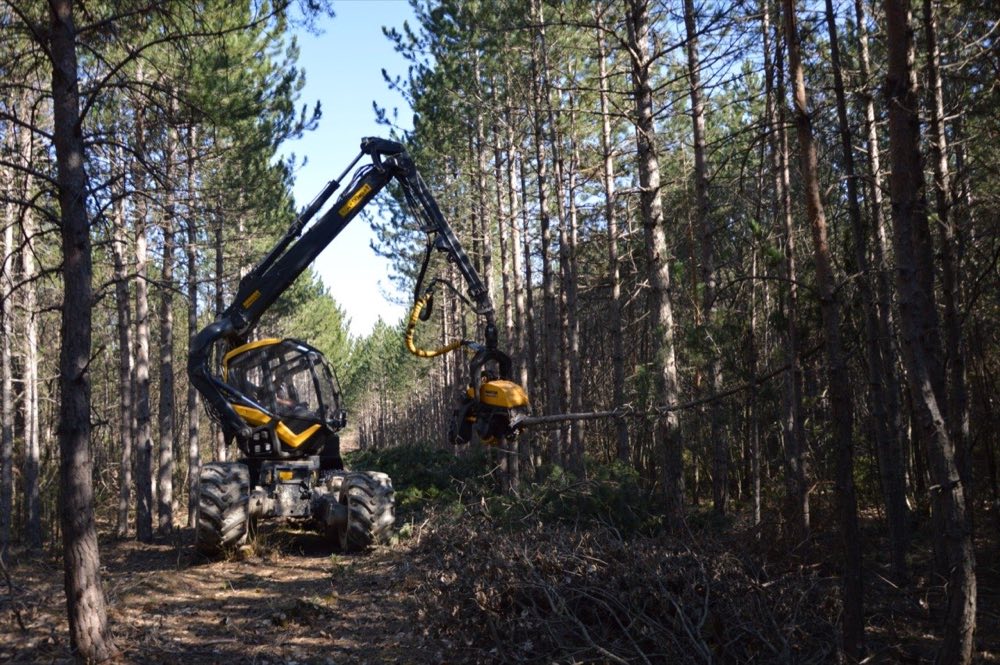
A forestry mulcher or stump grinder operates in conditions that would look extreme from a road milling perspective. The cutting teeth hit wood, rock, soil, root balls, embedded wire, and occasionally things that shouldn’t be in the ground but are. The loading is highly variable and frequently involves sudden impact rather than continuous cutting pressure.
The dominant failure mode in forestry cutting tools is chipping and fracture. A tooth that’s too hard will crack when it hits a rock inclusion or a dense knot. The carbide shatters rather than deforming, the tip detaches from the body, and the tooth fails catastrophically rather than wearing gradually.
For forestry applications, toughness takes priority over hardness in the carbide spec. That means higher cobalt content — typically 10–13% — and coarser grain structure. The tradeoff is faster abrasive wear on the carbide surface, but in forestry, the alternative (catastrophic fracture) is worse. A tooth that wears down predictably can be monitored and replaced on schedule. A tooth that chips unpredictably creates unplanned downtime and sometimes damages adjacent components when a fragment breaks free at operating speed.
The steel body also needs to be engineered for impact. The interface between the brazed carbide and the steel body is a stress concentration point, and repeated impact loading will eventually cause delamination if the brazing and the base material aren’t right. High-impact forestry applications need base materials with better toughness than standard tool steel — typically medium-carbon alloy steels with specific heat treatment profiles that balance hardness with ductility.
Hardfacing on the body steel (separate from the carbide tip) extends the service life of the tooth body itself, which is relevant in forestry applications where abrasive soil contact wears the body even between cutting cycles.
Road Milling: Abrasion Resistance Dominates
Cold planer bits operating on asphalt and concrete work in a fundamentally different wear environment. The loading is more consistent — continuous cutting pressure against a relatively homogeneous material rather than the variable impact loading of forestry. The dominant failure mode isn’t fracture; it’s abrasive wear.
Asphalt milling aggregate is highly abrasive. Concrete is worse. A cutting bit that runs through several hundred meters of road surface is grinding against silica, aggregate stone, and occasionally rebar at operating speed. The carbide needs to resist this abrasion over a long service interval, which means hardness takes priority over toughness.
For road milling bits, lower cobalt content (6–8%) and finer grain structure are appropriate — the exact opposite of what works in forestry. The harder, more abrasion-resistant carbide wears slower against aggregate, which is the primary cost driver in road milling maintenance.
The geometry is also different. Road milling bits typically use a conical point geometry that allows the bit to rotate in its holder during operation, distributing wear evenly around the circumference. This rotation is load-dependent — the bit only rotates effectively when the cutting force is above a threshold, which means the holder and bit shank interface matters as much as the carbide tip. A hard carbide tip on a bit that’s stuck in its holder and not rotating will develop flat spots and fail prematurely regardless of how good the carbide is.
Impact loading in asphalt milling is lower than in forestry, but it’s not zero. Seams, patches, expansion joints, and surface irregularities create intermittent impact events. The carbide spec for road milling needs to balance abrasion resistance against minimum toughness — enough cobalt to handle occasional impact without fracturing, not so much that abrasive wear accelerates.
Where the Specs Actually Diverge
To make this concrete: a stump grinder tooth running the carbide spec optimized for road milling will chip on the first rock impact. The harder, finer-grain carbide that handles asphalt aggregate doesn’t have the toughness for forestry impact loading. The failure is fast and visible.
The reverse is slower to show up. A road milling bit running a forestry carbide spec will wear faster than it should because the higher-cobalt, coarser-grain formulation sacrifices abrasion resistance. The bits look fine and work correctly — they just need replacement sooner than an optimized spec would require. This kind of underperformance often gets attributed to material quality generally rather than to a specific formulation mismatch.
Good tungsten carbide cutting tools are engineered for their specific application rather than specified generically. The visible geometry — tip shape, shank diameter, mounting interface — is the obvious differentiation between product types. The carbide formulation is the less visible variable that determines whether the part performs at the level it should in the operating environment it’s actually going into.
Evaluating Suppliers Across Both Categories
If your operation spans forestry and road maintenance, you need either one supplier who has engineered different carbide specs for each application, or separate suppliers for each category. What you don’t want is a single spec that’s supposed to work everywhere and is actually optimized for neither.
When evaluating a supplier who claims to cover both categories, ask specific questions about the carbide formulation differences between their forestry and milling product lines. If the answer is primarily about geometry — different tooth shapes, different shank sizes — and not about material specifications, that’s a signal that the carbide isn’t differentiated. A supplier who can tell you the cobalt percentage and grain size target for their stump grinder teeth versus their cold planer bits, and explain why those parameters differ, has done the engineering work.
Ask for application-specific sample data: what wear rate should you expect in your material conditions, and how was that number derived? Lab data is better than no data; field data from comparable applications is better than lab data. The answer tells you whether the supplier knows the application or just knows the product.
For both categories, the minimum information to request before a volume order is the carbide grade specification (typically referenced by ISO or ASTM grade), the hardness rating (HRA), and whether the carbide is brazed or hardfaced. These aren’t unreasonable requests — any manufacturer who’s actually engineered the product can provide them without difficulty.